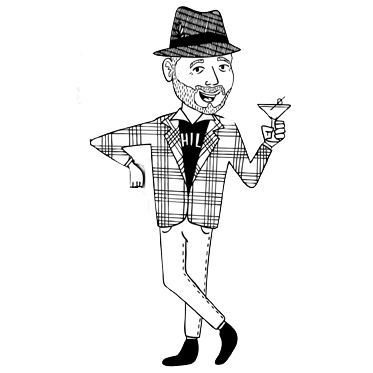

 What is French Fry Thursday? There is only way one to find out. Play quizzo tonight at the Ugly American at 8 p.m. and the Bards at 10:15 p.m. In addition to French Fry Thursday, I got free t-shirts to give away at Bards. Hope to see ya tonight!
Category: Uncategorized
Old Philly Postcards: The Hotel Walton
 One of the classiest hotels in Philadelphia at the turn of the 20th century was the brand new Hotel Walton. For a little background, we go to one of our favorite blogs, the one at Phillyhistory.org: The Hotel Walton, located on the southeast corner of Broad Street and Locust Street, opened in February 1896 and incorporated the Hotel Metropole, an earlier establishment on the same site. Upon its completion, the hotel featured a ladies’ restaurant, a gentlemen’s café, several parlors, a banquet hall, and 400 guest rooms (200 of which had separate baths). The hotel would eventually be known as the John Bartram Hotel before being demolished in the 1960s.
I stumbled onto a treasure trove of info about the Hotel here. Clumsy to maneuver, it is a paper written by the National Park Service on a typewriter many years ago and later uploaded onto the Web. Major thanks to whoever scanned it in.
The architect of the Hotel Walton was Angus Wade, who also designed the Hotel Hanover, the Bingham Hotel, and the Hotel Rittenhouse, all spectacular structures that no longer stand (The Hotel Rittenhouse is not the Rittenhouse Hotel, but rather a hotel that was at 21st and Chestnut.) Poor Angus. He did perhaps also design the still standing Carriage House, now a B&B near Penn on 46th Street, though there are no good photos of it on their website.
 Am I rambling on about a guy named Angus? Where was I? Ah yes, the Hotel Walton. There was a hotel called the Hotel Metropole at that address but the Hotel Walton incorporated it as part of the much larger Hotel Walton. It opened in February of 1896, and the paper includes the coolest thing I’ve found yet while researching these hotels: a Public Ledger article about the opening written on February 13, 1896. Here is the opening to the story, and a full description of the hotel is offered after the jump:
“Thousands of People thronged the new Hotel Walton from roof to basement last evening, on the occasion of its formal opening, when a scene of brilliancy was presented which has seldom been equalled in this city. The event served a two-fold purpose, as it not only showed off the magnificence of this new hostelry, but gave an opportunity for the gentler sex to display their new midwinter gowns.”
How did it get the name Walton? That info comes to us in the next article in the typewritten paper, which is actually from a year earlier:
The name Walton is in honor of a bright little son of Robert Goelet, who owns the property, Master Robert Walton Goelet, and the young lad is very proud of the distinction that has been shown him.
Robert Goulet was the original owner?!! Oh wait, nevermind, it’s Goelet, not Goulet. My bad. Anyways, I bet his son was an insuffereable, obnoxious punk about having that Hotel named after him. When he was in his early 20s, I bet he constantly bragged to women that he was the namesake of the Hotel Walton, but I bet the women blew him off anyway, because he was so annoying about it. I bet our boy Angus couldn’t stand the little punk, but kept up appearances when he came around, just so Robert Goulet Goelet wouldn’t get mad.
In 1946, the Hotel Walton went into bankruptcy. I suspect the spoiled rotten little brat who the hotel was named after spent all of the money on fast cars and easy women, but I am completely making that up and not basing it on any “facts” or “research”. Nonetheless, it went into bankruptcy in 1946 and reopened as the John Bartram Hotel in 1946. It was torn down in 1966. Ok, for a real treat, after the jump I’ll tell you where to find a bunch of pictures of the Hotel, what the postcards said, and post the entire 1896 description of the Hotel when it opened.
Old Philly Postcards: Wish You Were Here
 Big Pimpin’.
Happy Thanksgiving!
 Hope you and yours have a happy and safe Thanksgiving!
Quizzo Tonight
Yes, there is quizzo tonight. Locust Rendezvous at 6:15 p.m., Black Sheep at 8 p.m. Lots of turkey day questions, with some regular trivia in the Impossible Round to even it out. Hope to see ya tonight!
Daniel Sickles: Adulterer, Murderer, and Eccentric
Perhaps the most interesting Gettysburg character I learned about when I went there in 2009 was Major General Daniel Sickles, who nearly cost the Feds the victory with a foolhardy and movement of troops on Day 2 of the three day battle.
But his fascinating story begins before Gettysburg. He was a lawyer and later a New York Senator. He married a 15 year old named Teresa Bagioli when he was 33 and cheated on her with hookers regularly. She responded by carrying on an affair with Phillip Barton Key, son of Francis Scott Key. Sickles hunted down Key, who at the time was district attorney for Washington, D.C., and shot and killed him directly across the street from the White House in February of 1859. Sickles was arrested a few hours later. His lawyers, led by future Secretary of War Edwin Stanton, encouraged him to plead temporary insanity, and he said that his wife’s infidelity had caused him to temporarily lose his mind. It was the first time the temporary insanity defense had ever been used in the United States, and it worked. Sickles was acquitted of all charges.
His image was bruised however, when he forgave his wife for her infidelity (people generally supported the fact that he killed Key, but were outraged that he would forgive that little whore for cheating on him) and ever the politician, he knew that a gool old fashioned war could help repair it. Due to his political connections, he rapidly moved up the ranks, and soon was a Major General. He was also a good friend of General Hooker, and the two men often indulged in strong booze and cheap women.
 At Gettysburg, Sickles was ordered to protect the southern ridge by General Meade. He disobeyed orders and moved to a higher ground. His move stretched the Union Army out too thin, left the southern flank exposed, and infuriated Meade, who never forgave him. In addition, it allowed Sickles III Corps to be attacked from multiple sides. They were crushed by General Longstreet, and Sickles had one of his legs almost blown off by a cannon. To rally his men, he demanded that a cigar be placed in his mouth as he was led off the battlefield on a stretcher. After it was amputated, he had his leg preserved and sent to the Army Medical Museum in Washington, DC, where he would visit it every year on the anniversary of it’s destruction.
 He and Meade remained enemies, with Sickles claiming of course that he himself had been the true hero at the Battle of Gettysburg and Meade had smeared him and taken away the glory that was rightfully his.
After the war he became US Minister to Spain, where he reportedly carried on an affair with recently deposed Queen Isabella II. He returned to New York in 1874 and became head of the New York Monuments Commission (He was relieved of his post when in his early 90s it was discovered that $28,000 had gone missing from the commissions coffers). He also led the charge to make Gettysburg battlefield a national park when commercial interests were trying to take it over.
In 1913, in his 90s and in ailing health he went to Gettysburg for the 50th year anniversary for what he knew would be the last time. He spent part of that time taking swipes at General Meade. He died the next year at age 94.
While there are monuments dedicated to most of the generals who served at Gettysburg, there is none dedicated to Sickles. Why? Because he was in charge of the moneys for a bust of himself to be placed on the battlefield, and rumor is that he stole the money for himself. Thus there is a memorial today to his III Corps with an empty spot where the bust was to have gone. When asked why there was no monument to him at Gettysburg, Sickles replied, “The entire battlefield is a memorial to Dan Sickles.”
RELATED: How the Civil War saved Dan Sickles.
Headline of the Day
And in the Christian Science Monitor no less. (brought to my attention by Milo).
Quizzo Tonight
We kick it off at the Ugly American (Front and Federal) at 8 p.m. before moving on to the Bards at 10:15 p.m. There are rumors of some art questions. Hope to see you tonight!
Happy Birthday Booker T.
The leader of the band that gave us some of the funkiest jams of all time turns 65 today.
Root for Sam Today on Millionaire!
JGT friend and occasional quizzoite Sam Murray is competing today in the Tournament of Ten on Who Wants to Be a Millionaire! Be sure to tune in at 12:30 p.m. on WPVI to see how it turns out for Sam, who won $50,000 this past Friday on the show.